AI in Robotics: How Artificial Intelligence Is Building a Smarter Future
Admin
07 Nov 2026
45 views
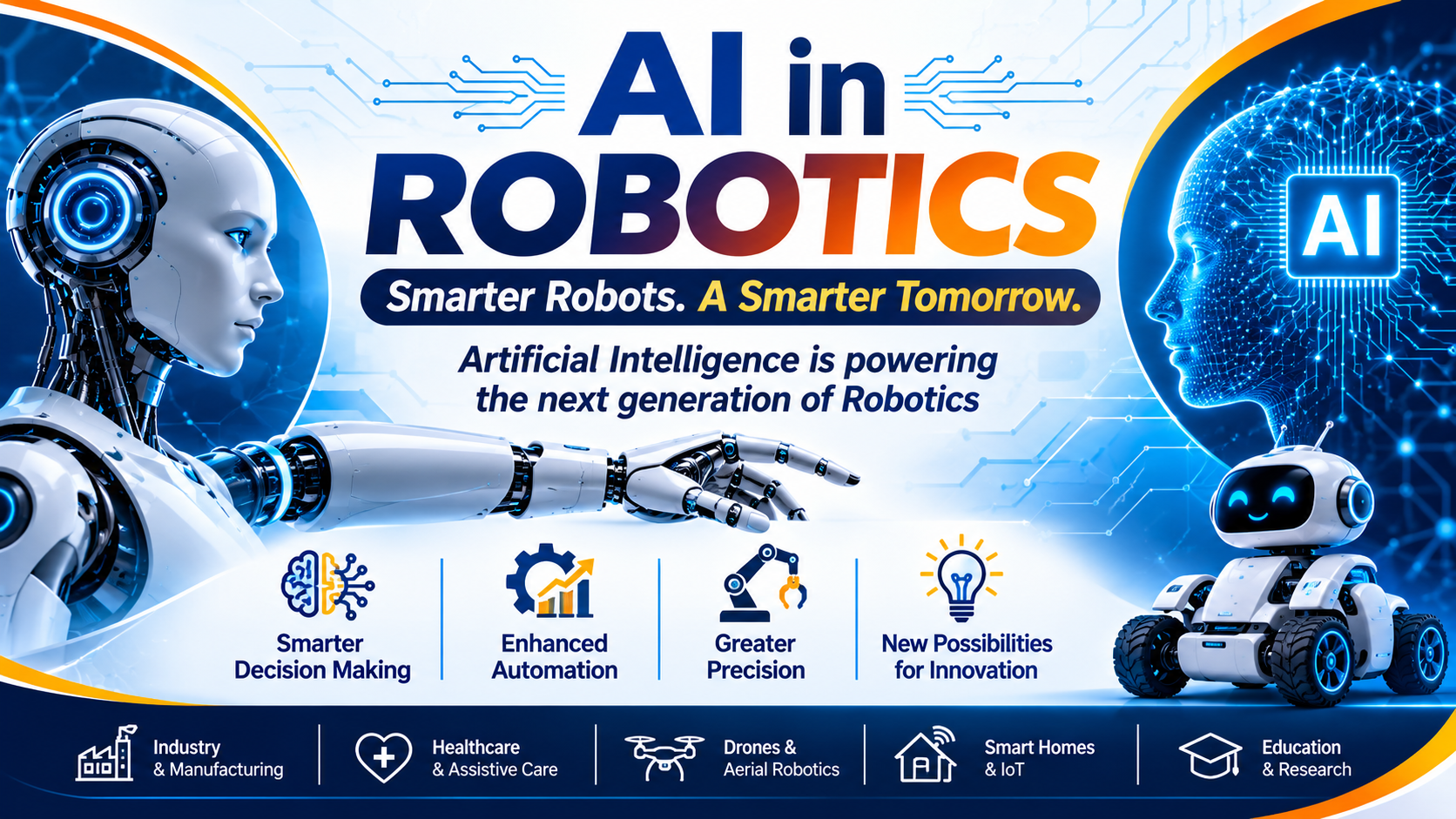
# AI in Robotics: How Artificial Intelligence Is Building a Smarter Future
**Smarter Robots. A Smarter Tomorrow.**
Imagine a robot that can recognise your face, understand your voice, make decisions, navigate through unfamiliar surroundings and perform complex tasks without constant human instructions.
This is no longer just science fiction. It is becoming a reality through the powerful combination of **Artificial Intelligence (AI) and Robotics**.
Artificial Intelligence is transforming traditional robots into intelligent machines that can observe, learn, analyse and respond to their surroundings. Together, AI and Robotics are shaping the next generation of technology.
## What Is AI in Robotics?
Robotics is the field of designing, developing and operating machines that can perform physical tasks. Artificial Intelligence enables these machines to process information, recognise patterns, make decisions and improve their performance.
When AI is integrated into robotics, robots become more than machines that simply follow programmed instructions. They gain the ability to respond intelligently to changing situations.
For example:
- A traditional robot follows a fixed path.
- An AI-powered robot can identify obstacles and find an alternative route.
- A traditional robotic arm performs repetitive movements.
- An AI-powered robotic arm can identify different objects and handle them accordingly.
This combination makes robots more adaptable, efficient and capable.
## How Does AI Make Robots Intelligent?
AI-powered robots use several technologies to understand and interact with the world.
**1. Machine Learning**
Machine Learning allows robots to learn from data and improve their performance over time. Instead of programming every possible situation, engineers can train robots using examples and experience.
**2. Computer Vision**
Computer Vision enables robots to see and understand images and videos. Using cameras and AI algorithms, robots can recognise objects, identify people, detect obstacles and inspect products.
**3. Natural Language Processing**
This technology allows robots to understand and respond to human language. It makes voice-controlled robots and conversational humanoids possible.
**4. Sensors and Real-Time Decision Making**
Robots use cameras, ultrasonic sensors, LiDAR, GPS and other sensing technologies to collect information about their surroundings. AI processes this information to help robots make decisions.
**5. Autonomous Navigation**
AI helps mobile robots, autonomous vehicles and drones navigate their surroundings, avoid obstacles and reach their destinations.
## Real-World Applications of AI in Robotics
AI in Robotics is already making a significant difference across industries.
### 1. Manufacturing and Industrial Automation
Smart industrial robots are transforming factories. They can assemble products, inspect quality, handle materials and perform repetitive tasks with greater consistency.
### 2. Healthcare and Medical Robotics
Robotic systems assist healthcare professionals in surgical procedures, rehabilitation, patient monitoring and medical logistics. AI helps these systems process information and support more precise operations.
### 3. Humanoid Robots
Humanoid robots are designed to interact with people and operate in human-oriented environments. With AI, they can understand speech, recognise faces, respond to questions and perform selected physical tasks.
### 4. Drones and Aerial Robotics
AI-powered drones can analyse images, identify objects, inspect infrastructure, support agriculture and assist in search-and-rescue operations.
### 5. Smart Homes and Personal Assistance
Intelligent robots can support household activities, provide assistance to elderly individuals and interact with smart home devices.
### 6. Education and Research
AI-powered robotic platforms are helping students, researchers and engineers explore programming, automation, machine learning, electronics and intelligent systems.
## AI + Robotics: The Technology Behind Tomorrow
The future of robotics will not depend only on mechanical engineering. It will require the integration of multiple disciplines.
Some of the important technologies include:
- Artificial Intelligence and Machine Learning
- Electronics and Embedded Systems
- Sensors and Actuators
- Mechanical and Mechatronics Engineering
- Computer Vision
- Internet of Things (IoT)
- Autonomous Systems
- Human-Robot Interaction
The integration of these technologies will enable the development of more capable and intelligent machines.
## Challenges in AI-Powered Robotics
Despite its enormous potential, AI in Robotics also presents challenges.
Some important considerations include:
- High development and implementation costs.
- Data privacy and cybersecurity.
- Safety and reliability.
- Ethical use of autonomous systems.
- Dependence on quality training data.
- Need for skilled professionals.
Responsible development and proper human supervision will remain essential as intelligent robots become more common.
## What Does the Future Hold?
We are moving towards a world where robots will increasingly work alongside humans.
Factories will become smarter, healthcare systems will adopt more advanced robotic assistance, autonomous machines will perform complex operations, and humanoid robots may become part of everyday environments.
However, the real opportunity is not simply about replacing human effort. It is about combining human intelligence, creativity and decision-making with the speed, precision and capabilities of intelligent machines.
## Conclusion: The Future Is Intelligent
AI is giving robots the ability to understand, learn and make decisions, while Robotics is giving AI the ability to interact with the physical world.
Together, they represent one of the most exciting technological developments of our time.
Whether you are a student exploring technology, a teacher preparing learners for future careers, an engineer developing intelligent machines or simply someone curious about innovation, understanding AI in Robotics is becoming increasingly important.
**The future will not just be about building robots. It will be about building robots that can think, learn and work intelligently alongside humans.**
*AI is the intelligence. Robotics is the action. Together, they are shaping tomorrow.*